1. Let A = {x : x is a natural number and a factor of 18}
B = {x : x is a natural number and less than 6}
Find A ∪ B and A ∩ B.
Solution:
A = {1, 2, 3, 6, 9, 18}
B = {1, 2, 3, 4, 5}
Therefore, A ∩ B = {1, 2, 3}
2. If P = {multiples of 3 between
1 and 20} and Q = {even natural numbers upto 15}. Find the intersection of the
two given set P and set Q.
Solution:
P = {multiples of 3 between 1 and 20}
So, P = {3, 6, 9, 12, 15, 18}
Q = {even natural numbers upto 15}
So, Q = {2, 4, 6, 8, 10, 12, 14}
Therefore, intersection of P and Q is the largest set containing only those
elements which are common to both the given sets P and Q
Hence, P ∩ Q = {6, 12}.
Showing posts with label Chap 3: Sets. Show all posts
Showing posts with label Chap 3: Sets. Show all posts
Wednesday, February 18, 2015

Sets: Notes
• The intersection of two sets can be represented by Venn diagram, with the shaded region representing A ∩ B.

A ∩ B when A ⊂ B, i.e., A ∩ B = A

A ∩ B when neither A ⊂ B nor B ⊂ A

A ∩ B = ϕ No shaded part
• The union of two sets can be represented by Venn diagrams by the shaded region, representing A ∪ B.


A ∪ B when neither A ⊂ B nor B ⊂ A

A ∪ B when A and B are disjoint sets
Relationship between the three Sets using Venn Diagram
• If ξ represents the universal set and A, B, C are the three subsets of the universal sets. Here, all the three sets are overlapping sets.
Let us learn to represent various operations on these sets.

A ∪ B ∪ C

A ∩ B ∩ C

A ∪ (B ∩ C)

A ∩ (B ∪ C)
Observe the Venn diagrams. The shaded portion represents the following sets.
(a) A’ (A prime)

(b) A ∪ B (A union B)

(c) A ∩ B (A intersection B)

(d) (A ∪ B)’ (A union B dash)

(e) (A ∩ B)’ (A intersection B dash)

(f) B’ (B prime)

For example;
Use Venn diagrams in different situations to find the following sets.

(a) A ∪ B
(b) A ∩ B
(c) A'
(e) (A ∩ B)'
(f) (A ∪ B)'
Solution:
ξ = {a, b, c, d, e, f, g, h, i, j}
A = {a, b, c, d, f}
B = {d, f, e, g}
A ∪ B = {elements which are in A or in B or in both}
= {a, b, c, d, e, f, g}
A ∩ B = {elements which are common to both A and B}
= {d, f}
A' = {elements of ξ, which are not in A}
= {e, g, h, i, j}
(A ∩ B)' = {elements of ξ which are not in A ∩ B}
= {a, b, c, e, g, h, i, j}
(A ∪ B)' = {elements of ξ which are not in A ∪ B}
= {h, i, j}
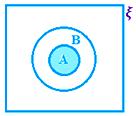
A ∩ B when A ⊂ B, i.e., A ∩ B = A
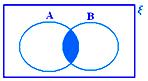
A ∩ B when neither A ⊂ B nor B ⊂ A
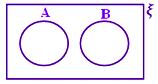
A ∩ B = ϕ No shaded part
• The union of two sets can be represented by Venn diagrams by the shaded region, representing A ∪ B.
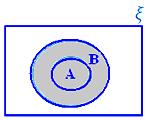
A ∪ B when A ⊂ B
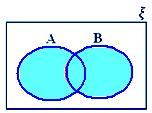
A ∪ B when neither A ⊂ B nor B ⊂ A
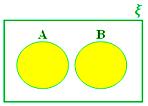
A ∪ B when A and B are disjoint sets
Relationship between the three Sets using Venn Diagram
• If ξ represents the universal set and A, B, C are the three subsets of the universal sets. Here, all the three sets are overlapping sets.
Let us learn to represent various operations on these sets.
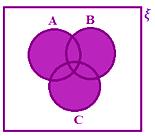
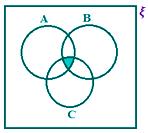
A ∩ B ∩ C
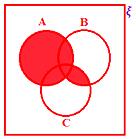
A ∪ (B ∩ C)
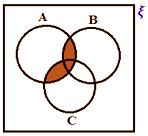
A ∩ (B ∪ C)
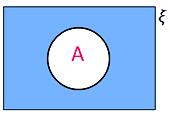
Observe the Venn diagrams. The shaded portion represents the following sets.
(a) A’ (A prime)
(b) A ∪ B (A union B)
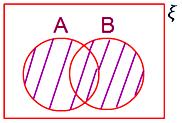
(c) A ∩ B (A intersection B)
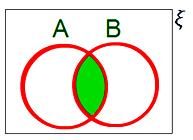
(d) (A ∪ B)’ (A union B dash)
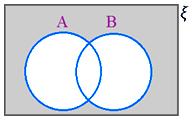
(e) (A ∩ B)’ (A intersection B dash)
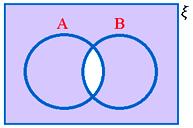
(f) B’ (B prime)
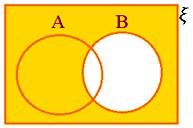
For example;
Use Venn diagrams in different situations to find the following sets.
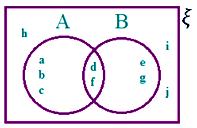
(b) A ∩ B
(c) A'
(e) (A ∩ B)'
(f) (A ∪ B)'
Solution:
ξ = {a, b, c, d, e, f, g, h, i, j}
A = {a, b, c, d, f}
B = {d, f, e, g}
A ∪ B = {elements which are in A or in B or in both}
= {a, b, c, d, e, f, g}
A ∩ B = {elements which are common to both A and B}
= {d, f}
A' = {elements of ξ, which are not in A}
= {e, g, h, i, j}
(A ∩ B)' = {elements of ξ which are not in A ∩ B}
= {a, b, c, e, g, h, i, j}
(A ∪ B)' = {elements of ξ which are not in A ∪ B}
= {h, i, j}
Chapter 3: Extra Exercise
Practice Test on Operations on Sets
1. If A = {2, 3, 4, 5} B = {4, 5, 6, 7} C = {6, 7, 8, 9} D = {8, 9, 10, 11}, find
(a) A ∪ B
(b) A ∪ C
(c) B ∪ C
(d) B ∪ D
(e) (A ∪ B) ∪ C
(f) A ∪ (B ∪ C)
(g) B ∪ (C ∪ D)
2. If A = {4, 6, 8, 10, 12} B = {8, 10, 12, 14} C = {12, 14, 16} D = {16, 18}, find
(a) A ∩ B
(b) B ∩ C
(c) A ∩ (C ∩ D)
(d) A ∩ C
(e) B ∩ D
(f)(A ∩ B) ∪ C
(g) A ∩ (B ∪ D)
(h) (A ∩ B) ∪ (B ∩ C)
(i) (A ∪ D) ∩ (B ∪ C)
3. Let ξ = {1, 2, 3, 4, 5, 6, 7} and A = {1, 2, 3, 4, 5} B = {2, 5, 7} show that
(a) (A ∪ B)' = A' ∩ B'
(b) (A ∩ B)' = A' ∪ B'
(c) (A ∩ B) = B ∩ A
(d) (A ∪ B) = B ∪ A
4. Let P = {a, b, c, d} Q = {b, d, f} R = {a, c, e} verify that
(a) (P ∪ Q) ∪ R = P ∪ (Q ∪ R)
(b) (P ∩ Q) ∩ R = P ∩ (Q ∩ R)
Answers for practice test on operations on sets are given below to check the correct answers
(b) {12, 14}
(c) ∅
(d) {12}
(e) d
(f) {8, 10, 12, 14, 16}
(g) {8}
(h) {8, 10, 12, 14}
(i) {8, 10, 12, 16}
3. (a) L.H.S. = R. H. S = {6}
(b) L.H.S. = R. H. S = {1, 3, 4, 6, 7}
(c) {2, 5}
(d) {1, 2, 3, 4, 5, 7}
4. (a) {a, b, c, d, e, f}
(b) d
1. If A = {2, 3, 4, 5} B = {4, 5, 6, 7} C = {6, 7, 8, 9} D = {8, 9, 10, 11}, find
(a) A ∪ B
(b) A ∪ C
(c) B ∪ C
(d) B ∪ D
(e) (A ∪ B) ∪ C
(f) A ∪ (B ∪ C)
(g) B ∪ (C ∪ D)
2. If A = {4, 6, 8, 10, 12} B = {8, 10, 12, 14} C = {12, 14, 16} D = {16, 18}, find
(a) A ∩ B
(b) B ∩ C
(c) A ∩ (C ∩ D)
(d) A ∩ C
(e) B ∩ D
(f)(A ∩ B) ∪ C
(g) A ∩ (B ∪ D)
(h) (A ∩ B) ∪ (B ∩ C)
(i) (A ∪ D) ∩ (B ∪ C)
3. Let ξ = {1, 2, 3, 4, 5, 6, 7} and A = {1, 2, 3, 4, 5} B = {2, 5, 7} show that
(a) (A ∪ B)' = A' ∩ B'
(b) (A ∩ B)' = A' ∪ B'
(c) (A ∩ B) = B ∩ A
(d) (A ∪ B) = B ∪ A
4. Let P = {a, b, c, d} Q = {b, d, f} R = {a, c, e} verify that
(a) (P ∪ Q) ∪ R = P ∪ (Q ∪ R)
(b) (P ∩ Q) ∩ R = P ∩ (Q ∩ R)
Answers for practice test on operations on sets are given below to check the correct answers
Answers:
1. (a) {2, 3, 4, 5, 6, 7}
(b) {2, 3, 4, 5, 6, 7, 8, 9}
(c) {4, 5, 6, 7, 8, 9}
(d) {4, 5, 6, 7, 8, 9, 10, 11}
(e) {2, 3, 4, 5, 6, 7, 8, 9}
(f) {2, 3, 4, 5, 6, 7, 8, 9}
(g) {4, 5, 6, 7, 8, 9, 10, 11}
2. (a) {8, 10, 12}(b) {2, 3, 4, 5, 6, 7, 8, 9}
(c) {4, 5, 6, 7, 8, 9}
(d) {4, 5, 6, 7, 8, 9, 10, 11}
(e) {2, 3, 4, 5, 6, 7, 8, 9}
(f) {2, 3, 4, 5, 6, 7, 8, 9}
(g) {4, 5, 6, 7, 8, 9, 10, 11}
(b) {12, 14}
(c) ∅
(d) {12}
(e) d
(f) {8, 10, 12, 14, 16}
(g) {8}
(h) {8, 10, 12, 14}
(i) {8, 10, 12, 16}
3. (a) L.H.S. = R. H. S = {6}
(b) L.H.S. = R. H. S = {1, 3, 4, 6, 7}
(c) {2, 5}
(d) {1, 2, 3, 4, 5, 7}
4. (a) {a, b, c, d, e, f}
(b) d
Friday, January 23, 2015


Subscribe to:
Posts (Atom)